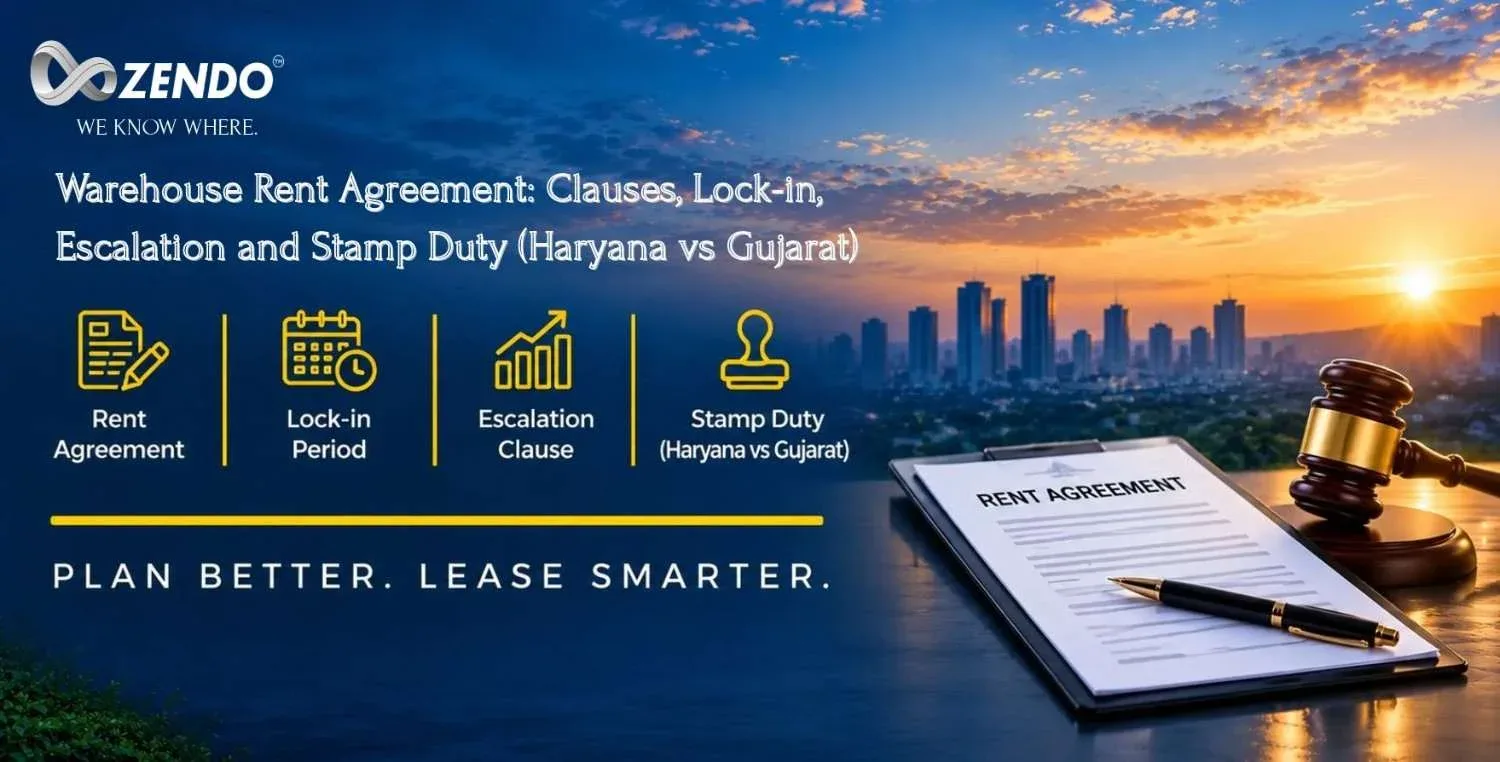
A warehouse rent agreement is a legal contract between a property owner and a tenant that defines the terms under which the tenant can use the property for storage or business operations. It involves more than just rent and the lease period. It also establishes responsibilities for maintenance, permitted use, security deposits, and early termination.
Unclear or incomplete terms can lead to disputes, unexpected expenses and operational difficulties during the tenancy. This guide explains the essential clauses, lock-in periods, rent escalation terms, and stamp duty requirements, with a comparison of the applicable provisions in Haryana and Gujarat.
What Is a Warehouse Rent Agreement?
A warehouse rent agreement is a written contract between a property owner and a tenant that establishes the conditions for using a warehouse. It covers rent, security deposits, lease duration, permitted activities, maintenance responsibilities and termination conditions.
Although the terms rent agreement and lease deed are sometimes used interchangeably, they can have different legal implications depending on the nature and duration of the arrangement. Where a lease is for a term of over one year, from year to year or a rent reserved from year to year, it is usually required that it be registered under Section 17 of the Registration Act, 1908.
A standard commercial lease agreement format in India should include:
-
Owner and tenant information, including details about identification.
-
A complete description of the property, including its address, carpet or built-up area, boundaries and identifying details.
-
The length of the lease and the monthly rent, and the security deposit.
-
Rights and responsibilities and allowed use of premises.
-
Termination conditions, dispute resolution provisions and signatures of both parties.
Businesses must also review the documents they need for a warehouse rent agreement before completing the documents. The agreement process can be delayed if the ownership records, authorisations or company documents are missing.
Key Clauses Every Warehouse Rent Agreement Should Have
A warehouse may be used for storage, distribution, packaging or manufacturing-related activities. The agreement should reflect the actual business requirements instead of relying on a basic residential-style rental format.
1. Rent and Security Deposit
The agreement should clearly mention the monthly warehouse rent, payment due date, accepted payment method and applicable late-payment charges. It should also include an explanation of how the rental arrangement will be treated under the GST regime and, if applicable, who will be collecting the tax on this arrangement.
Security deposits are commonly calculated as a number of months' rent, depending on the property and commercial terms. The agreement should clearly specify:
-
The amount of the total deposit made and the date of deposit.
-
Conditions under which deductions can be made.
-
The due date for the balance due.
-
If any unpaid utility bills or damages to the property are adjusted against it, it is not a problem.
If the tenant leaves behind any damaged shutters or unpaid electricity bills, the agreement should outline how this will be measured and recouped. This minimises conflict when it comes time to hand over possession.
2. Lock-in Period and Notice Period
A lock-in period is the agreed duration during which a party cannot terminate the arrangement without facing the consequences specified in the contract. A notice period, on the other hand, is the advance warning required when termination is permitted.
These terms should not be confused. An agreement might provide for a two-year lock-in followed by a three-month notice period. It should also clarify whether the tenant must pay the remaining lock-in rent, a specified penalty or another agreed amount if they leave early.
For warehouse tenants, this matters because relocation can involve shifting inventory, arranging transport and finding another suitable facility. Owners also need sufficient time to identify a replacement tenant.
3. Rent Escalation Clause
Commercial warehouse agreements often include a fixed rent increase after a specified period. An annual increase of 5% to 10% may be negotiated in some arrangements, while others provide for an increase at renewal.
There is no universal legal escalation percentage. The owner and tenant should agree on the exact rate and include it in writing.
The clause should explain when the increase begins, whether it is calculated on the original rent or the revised rent, and how frequently it applies. A clear calculation prevents disagreements when the next rental period begins.
4. Maintenance, Power and Utilities
Responsibility for maintenance should be divided clearly. The agreement should identify who pays for electricity, water, common-area maintenance, property tax and routine repairs.
For an industrial warehouse for rent, electricity capacity and operational infrastructure can directly affect business activity. Confirm the sanctioned power load, backup arrangements, water availability, drainage, loading facilities and access for heavy vehicles before signing.
It is also useful to distinguish structural repairs from everyday upkeep. The owner may be responsible for major structural issues, while the tenant may handle routine maintenance and damage caused by their operations, depending on the agreed terms.
5. Permitted Use and Subletting
The terms of the agreement should cover what can be done within the warehouse. Variations in storage, packaging, distribution and other commercial operations may be required, especially where special handling or regulatory permission is required.
Indicate if hazardous materials or restricted goods are not allowed. Explain if the tenant may sublet the premises, any structural changes, and any other business that may occupy the premises.
If heavy machinery, further storage racks or specialised electrical equipment is to be installed then permission, where required, should be obtained in writing. Issuing verbal approval can be an issue if the owner of the property contests in court later.
6. Termination, Disputes and Handover
The agreement should list the circumstances under which either party can terminate the arrangement. These may include non-payment of rent, unauthorised use, breach of contractual conditions or failure to meet agreed responsibilities.
It should also specify the process for resolving disputes, including the agreed jurisdiction or arbitration mechanism where applicable.
At the time of possession, record the property's condition through photographs, an inventory and meter readings. These records help establish the condition in which the warehouse was handed over and provide a reference when the tenant vacates.
Stamp Duty on Warehouse Rent Agreement: Haryana vs Gujarat
Stamp duty depends on the applicable state law, lease duration and the value used to calculate the duty. The tenant commonly bears this expense unless the parties agree otherwise, subject to applicable legal provisions. Registration charges are separate and should also be considered while estimating the total documentation cost.
Stamp Duty on Rent Agreement in Haryana
Haryana has its own stamp duty provisions for lease documents. The amount payable depends on the lease terms and the applicable state schedule. Figures such as 1.5% of average annual rent for shorter leases and 3% for certain longer terms are sometimes quoted, but these should not be treated as confirmed rates without checking the current schedule and the specific agreement.
Registration is generally compulsory for leases covered by Section 17 of the Registration Act, 1908. This includes leases from year to year, for a term exceeding one year, or reserving yearly rent.
These requirements are relevant to businesses exploring a warehouse for rent in Gurgaon, as well as properties in Faridabad and Sonipat. Before signing, owners and tenants should confirm the applicable duty and registration charges with the relevant Haryana authority.
Stamp Duty on Rent Agreement in Gujarat
Gujarat follows its own stamp duty schedule and amendments for lease documents. The applicable rate should be checked against the current state provisions because the calculation can vary with the lease duration and other contractual details. Older online estimates may not reflect the latest changes.
The registration requirements under Section 17 of the Registration Act, 1908, also apply to leases that fall within its scope. Businesses considering a warehouse for rent in Ahmedabad, Vithalapur or Becharaji should confirm the current stamp duty and registration requirements before executing the agreement.
| Consideration | Haryana | Gujarat |
| Stamp duty | Based on the applicable state schedule and lease terms | Based on the applicable state schedule and lease terms |
| Registration | Required for leases covered by Section 17 | Required for leases covered by Section 17 |
| Verification | Confirm current duty with the Haryana registration authority | Confirm current duty with the Gujarat registration authority |
You can use the stamp duty calculator to get an initial estimate. However, confirm the final amount with the relevant state registration authority or a qualified professional before executing the document. The payable duty should be checked on the date of execution.
Dos for Owners and Tenants
Some things to keep an eye on before signing will help avoid problems later on:
-
Write down all the terms, including verbal terms.
-
Verify the lock-in period, notice period and escalation percentage.
-
Pay stamp duty and register the document as appropriate.
-
Photographs of the warehouse and recording the condition at handover.
-
Specify who pays registration charges, maintenance and utility bills.
-
Check the company authorisation and the title documents of the owner.
-
Have copies of the agreement and payment information signed.
No parties should depend on a handwritten agreement when there can be a clear written agreement that documents the responsibilities.
Conclusion
A warehouse lease should support your business plans without leaving room for avoidable legal or financial complications. Read through each and every clause, pay attention to the stamp duty applicable, and ensure the lock-in, rent escalation and exit clauses are in agreement. A well-documented warehouse rent agreement provides greater support for the rental agreement.
Looking for the right warehouse or planning to lease out your property? Talk to ZENDO to get help and guidance of warehouse opportunities around Delhi NCR and Gujarat. Let the team know your location and space needs as well as your business needs to move forward in finding an appropriate property.