A business storing 5,000 cartons of finished goods has very different space requirements from a manufacturer operating heavy machinery or a wholesaler holding bulk inventory. However, similar businesses frequently appear related to industrial property listings known as warehouses, godowns, or industrial sheds.
The difference is significant, as it can impact the efficiency of business operations as it relates to building design, floor capacity, loading access, and allowed use. Understanding the difference between warehouse and godown, and where an industrial shed fits, helps businesses choose space that serves their actual operational needs.
What Is a Warehouse?
A warehouse is a commercial facility used to store, organise and distribute goods. It helps businesses to control the raw materials, finished products and stock prior to delivery to retailers, distributors or customers.
A good warehouse will facilitate inventory management and have various facilities such as:
-
Organised storage racks and high ceilings.
-
Wide vehicle access/loading dock.
-
Special compartment for receiving, packing, and dispatch.
-
Space for equipment for the handling of materials.
E-commerce businesses, FMCG brands, retailers, and logistics providers are typical examples of warehouse users. For instance, an e-commerce company can have particular racks for storing products, consider stock management, and immediately shift customers' orders to the packing and shipping part.
When looking for warehouse space for rent, consider the loading facilities, ceiling height, and loading volume, and how vehicles access it. These are features that can be the make-or-break factor in your daily business.
What Is the Meaning of Godown?
The godown meaning in the Indian commercial property market generally refers to a building or covered space used for storing goods in bulk. It is often used by wholesale, trading, farming, and distribution companies that need to store products prior to sale and/or delivery.
Traditional godowns are simply built, may have large covered spaces, simple floors, a shutter and low internal divisions. Modern godowns can have improved ventilation, security systems, loading areas, and organised storage facilities.
Common uses include:
-
Agricultural produce, grains and food supplies.
-
Construction materials, hardware and building supplies.
-
Wholesale products and packaged goods.
-
Industrial raw materials and spare parts.
For instance, a building materials supplier may use a godown to store cement bags, tiles, pipes and other products before distributing them to local retailers or construction sites.
The distinction between a godown and a warehouse is not always strict. In everyday Indian property transactions, both terms may describe spaces used for storing goods. The difference often comes down to the building's infrastructure, storage systems, scale, and intended operations.
If a business needs a godown for rent, it should check whether the property can safely accommodate its goods, vehicles and expected storage volume rather than relying only on the property's name.
What Is an Industrial Shed?
The industrial shed is a building that is used mainly for manufacturing, manufacturing and fabrication, assembly, processing and workshop activities and also has a roof. It is typically an open-floor construction to facilitate the installation of equipment, layout of production lines and movement of materials within the facility.
A number of industrial sheds are constructed of steel framework and a metal roof, with wide floor spaces. They may also need reinforced floors, proper electrical connections, ventilation systems, and appropriate facilities for machinery, depending on the type of application.
These properties are commonly used by:
-
Manufacturing and engineering companies.
-
Metal fabricators and assemblers.
-
Packaging and processing-related enterprises.
-
Workshops and manufacturers of equipment.
Let's take an example of a small metal-component manufacturer. It must have room for raw materials, cutting machines, welding apparatus, employees and finished materials. Generally, an industrial shed will be more suitable than a conventional storage warehouse if it has appropriate flooring and has the power supply and ventilation that are required.
If a business is interested in renting out a commercial shed or factory space, it is important to find out if the space is approved for the type of business. Having an open structure doesn't necessarily mean it's capable of supporting heavy equipment and production processes.
Warehouse vs Godown vs Industrial Shed: Key Differences
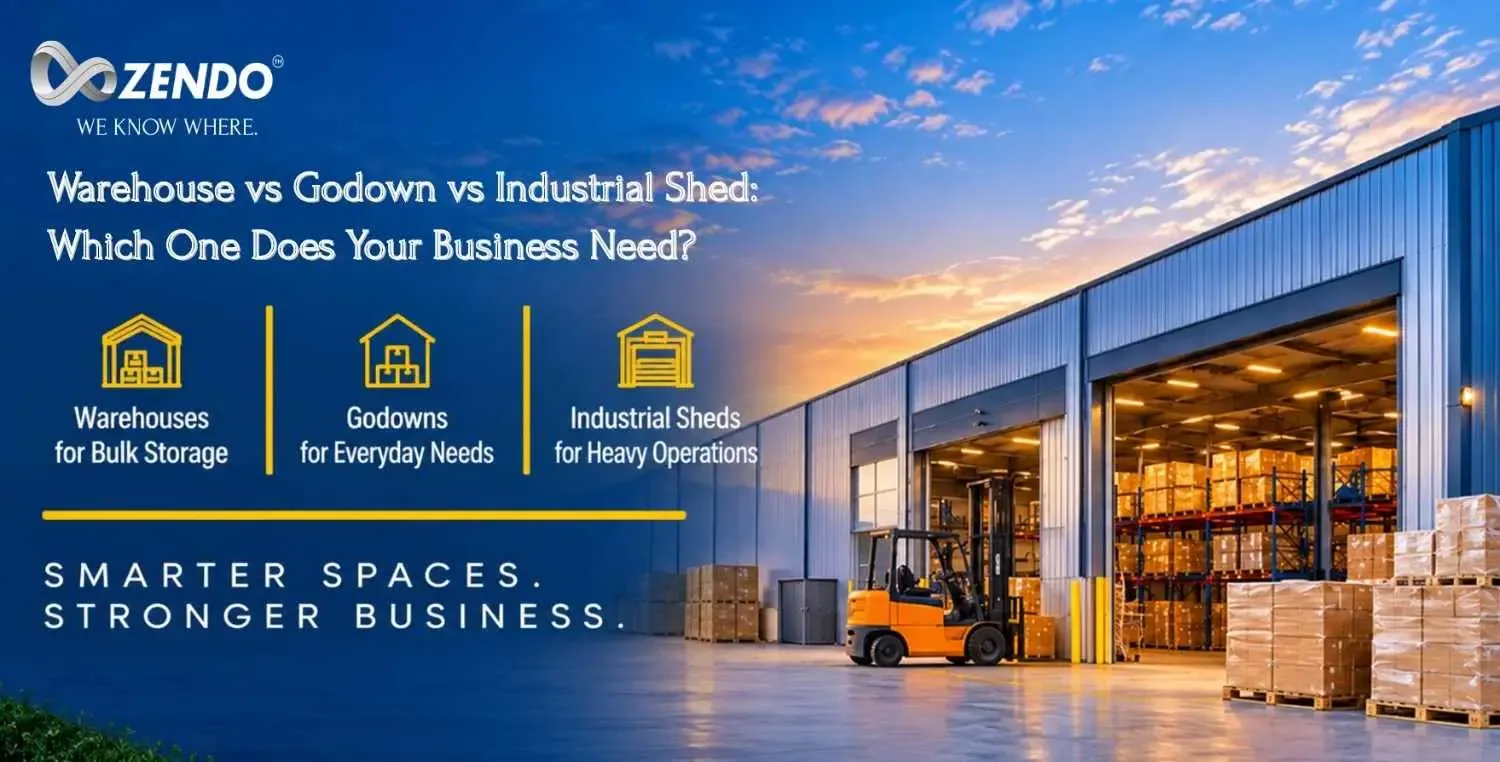
The main distinction between these properties lies in how the space is designed and used. A warehouse generally supports organised storage and distribution, a godown provides bulk storage, and an industrial shed accommodates production-related activities.
| Comparison factor | Warehouse | Godown | Industrial shed |
| Primary purpose | Storage and distribution | Goods storage | Manufacturing and industrial activities |
| Structure | Purpose-built storage facility | Traditional or modern storage building | Steel or other industrial structure |
| Layout | Organised storage and inventory areas | Flexible storage space | Open operational floor space |
| Infrastructure | Racking, loading docks and handling facilities | Basic to moderate storage facilities | Machinery, electrical and ventilation provisions |
| Common users | Logistics, retail and e-commerce | Wholesalers and traders | Manufacturers and fabricators |
| Main activity | Inventory management and dispatch | Bulk goods storage | Production and processing |
However, these categories are not completely separate. A modern godown may have loading docks, organised racks and inventory management facilities similar to a warehouse. Similarly, an industrial shed may be used to store raw materials or finished products when its structure, permissions and facilities support that purpose.
The important question is not simply what a property is called. It is whether its construction, infrastructure and permitted usage match your business requirements.
Industrial Shed vs Warehouse: Which One Should You Choose?
The first step in industrial shed vs warehouse is to consider the business activities that will take place inside the property.
During a discussion about warehouse usage, you should consider whether your business needs:
-
Large inventory volume and organised storage.
-
Regularly loading and unloading of goods.
-
Order picking, packing and dispatch.
-
Pallets and material handling equipment.
-
Sales of final products at several locations.
A shed used for an industrial purpose is a more appropriate choice when your business needs:
-
Manufacturing or production plants.
-
Heavy Equipment and machinery installation.
-
Fabrication, assembly or processing activities.
-
Special electrical load and ventilation requirements.
-
Clear floor areas to move equipment or to work.
For instance, a furniture retailer with finished products in the warehouse will require a warehouse, and a manufacturer with cutting machines and assembly lines will typically be looking for an industrial shed.
Always check the structural capacity, electrics, condition of the building, and land use before leasing either property. A favorable-looking property at the assessor's view cannot always be successfully used until major changes have been made to the property at considerable expense.
Which Property Type Is Suitable for Different Businesses?
The right property depends on the nature of your business, how frequently goods move and what facilities your operations require. A particular type of cold storage building may be required for a business that handles perishable food products, pharmaceuticals, or other temperature-sensitive products, not a standard godown or warehouse.
Likewise, a new distributor that's beginning their operations in a simple storage building will eventually need a new warehouse with a more convenient loading area and inventory management.
Consider your current operations as well as the facilities you may need over the next few years. A well-known problem that arises is that the real estate selection might only address current needs, which can lead to further relocation and infrastructure expenses as the business grows.
What Should You Check Before Renting a Warehouse, Godown or Industrial Shed?
Finding a property with the right size and rental price is only the first step. Its actual suitability depends on several practical and legal considerations.
-
Location and connectivity: Check how easily trucks and commercial vehicles can reach the property. Proximity to highways, suppliers, customers and transport routes can reduce delivery time and logistics expenses. Labour availability is another important consideration.
-
Space and layout: Look beyond the total area mentioned in the listing. Check usable floor space, ceiling height, column spacing, entry gates and vehicle movement. A property may have sufficient square footage but still create difficulties during loading or internal movement.
-
Flooring and structural capacity: Heavy inventory, industrial equipment and machinery require suitable load-bearing capacity. Inspect the flooring and building structure before moving materials or installing equipment.
-
Electricity and utilities: Verify the sanctioned electricity load, water supply, drainage and ventilation. Manufacturing units may require considerably more power than businesses using the premises only for storage.
-
Safety and security: Check fire safety arrangements, emergency exits, CCTV coverage, access control and the availability of firefighting equipment. The requirements will vary depending on the property type and the goods or activities involved.
-
Legal approvals and lease conditions: Verify ownership documents, permitted land use, building approvals and applicable commercial or industrial permissions. Review the lease duration, security deposit, maintenance responsibilities, rent escalation clauses, and restrictions on property usage.
Before finalising a property, inspect the premises to ensure its structure, facilities and approved usage match your business requirements. Also, verify the ownership documents and lease conditions to avoid unexpected repair costs, compliance issues or operational delays after taking possession. A thorough inspection will help you make a more informed decision when choosing a warehouse for lease.
What Factors Affect Warehouse and Industrial Space Rental Costs?
Rental price is different depending on the location, construction, infrastructure and suitability of the premises for business operations. Facilities and availability of the two properties will also vary, and two similar floor area properties can have vastly different rents.
Some of the key factors are:
Rent premiums may be received for properties that are close to roads, industrial facilities, passenger rail lines, and markets.
-
The size of the property: This includes the total usable area, height of the ceiling, and internal arrangement; this will determine the amount of operational space that a business gets.
-
Construction quality: It includes the condition of the building, the flooring, roofing, and structural strength that impacts the value of the property.
- Rental Costs may be affected by available infrastructure: loading docks, power supply, security systems, ventilation and storage facilities etc.
- Vehicle access: Parking space, truck movement and loading facilities are of great importance for logistics operations.
- Other costs: Utility and maintenance bills, security fees and property service costs can add up to the monthly bill.
- Security deposit: How much is a deposit required?Lease length and rent increases: What does the rental lease term look like and what happens if rent raises?
Don't only look at the monthly rental rate when comparing the rent for industrial space or when considering a warehouse for rent. Lower-priced properties may need any or all of flooring renovations, electrical changes or travel costs. Estimate expenses to become a functioning property prior to signing the lease.
How to Choose the Right Commercial Property for Your Business
One of the best ways to winnow the selection is to compare the properties with your real working needs.
-
Identify your business activity: Decide whether your primary business activity is storage, distribution, manufacturing, processing or a mix of all. This will assist you in narrowing down the identification of the kinds of property you require to shortlist.
-
Determine infrastructure needs: Determine floor area, storage needs, power, loading access and machinery needs. Allow room for future inventory, movement of vehicles, and workers.
-
Assess the suitability of the property: Consider the location, condition of the property, facilities available, and legal rights and lease conditions. Be careful not to take it for granted that a property will be appropriate just because it's being marketed as an industrial shed or warehouse.
-
Consider future expansion: Do you think you will be able to expand to hold more inventory, more equipment, more staff or more output? The arrangement should provide for a viable and convenient expansion without necessitating an immediate move.
Conclusion
Warehouses, godowns and industrial sheds have a variety of operational requirements and sometimes may seem like the same thing.
It is the right approach for a specific enterprise depending on how goods are stored, how distribution or how production is conducted. Prior to leasing, consider the infrastructure, location, usage restrictions and operating costs of the property.
Depending on a business's needs, ZENDO can help them research the best warehouse, godown or industrial property for their aims and plans and find commercial property that can help them achieve their goals.